53 lines
3.5 KiB
Markdown
53 lines
3.5 KiB
Markdown
 
|
[Download](https://presentations-decks-uploads-prod.s3.amazonaws.com/7403838/3888537/d7d22c9c3f0b5ebadec559f8674a1cc0830ef7ceed32211f489adeefce60aefe.pdf?X-Amz-Algorithm=AWS4-HMAC-SHA256&X-Amz-Date=20260910T074648Z&X-Amz-SignedHeaders=host&X-Amz-Expires=60&X-Amz-Credential=AKIAZ32RUKUMSNCVYAKB%2F20260910%2Fus-east-1%2Fs3%2Faws4_request&X-Amz-Signature=9af994d3996464c9abb7aa76139830a4591bb294404a2ad9757ebc9e7cc99f68)
|
|||
|
|
|
|||
|
|
This data sheet contains approximate values that may vary with build conditions and is intended for reference and comparison purposes only. It should not be used for
|
|||
|
|
design specifications or quality control. The performance characteristics of the material may be affected (±) by, but are not limited to, part design, part geometries,
|
|||
|
|
application and operating conditions. Each user is responsible for determining that the material is safe, lawful and technica lly suitable for the intended laws and
|
|||
|
|
regulations. A DDITIVA makes no warranties of any kind, express or implied, including, but not limited to, the warranties of merchantability, fitness for a particular use, or
|
|||
|
|
warranty against patent infringement. ADDITIVA excludes liability, however arising, for any inac curacies in this document.
|
|||
|
|
ADDITIVA\_Stainless Steel 316L\_rev006.docx
|
|||
|
|
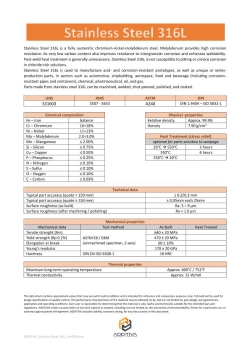
Stainless Steel 316L is a fully austenitic chromium \- nickel \- molybdenum steel. Molybdenum provides high corrosion
|
|||
|
|
resistance. Its very low carbon content also improves resistance to intergranular corrosion and enhances weldability.
|
|||
|
|
Post \- weld heat treatment i s generally unnecessary. Stainless Steel 316L is not susceptible to pitting or crevice corrosion
|
|||
|
|
in chloride \- rich solutions.
|
|||
|
|
Stainless Steel 316L is used to manufacture acid \- and corrosion \- resistant prototypes, as well as unique or series \-
|
|||
|
|
production parts,in sectors such as automotive, shipbuilding, aerospace, food and beverage (including corrosion \-
|
|||
|
|
resistant pipes and containers), chemical, pharmaceutical, oil, and gas.
|
|||
|
|
Parts made from stainless steel 316L can be machined, welded, shot \- peened, polished, and coated.
|
|||
|
|
UNS AMS ASTM DIN
|
|||
|
|
S31603 5507 \- 5653 A240 DIN 1.4404 – ISO 5832 \- 1
|
|||
|
|
Chemical composition Physical properties
|
|||
|
|
Fe – Iron balance Relative density Approx. 99.9%
|
|||
|
|
Cr – Chromium 16÷18% Density 7.90 g/cm 3
|
|||
|
|
Ni – Nickel 11÷13%
|
|||
|
|
Mo – Molybdenum 2.0÷3.0% Heat Treatment (stress relief)
|
|||
|
|
Mn – Manganese ≤ 2.00% optional for parts sensitive to warpage
|
|||
|
|
Si – Silicon ≤ 0.75% 20°C → 550°C 3 hours
|
|||
|
|
Cu – Copper ≤ 0.50% 550°C 6 hours
|
|||
|
|
P – Phosphorus ≤ 0.25% 550°C → 20°C \-
|
|||
|
|
N – Nitrogen ≤ 0.10%
|
|||
|
|
S – Sulfur ≤ 0.10%
|
|||
|
|
O – Oxygen ≤ 0.10%
|
|||
|
|
C – Carbon ≤ 0.03%
|
|||
|
|
Technical data
|
|||
|
|
Typical part accuracy (quote < 150 mm) ± 0.2/0.3 mm
|
|||
|
|
Typical part accuracy (quote ≥ 150 mm) ± 0.05mm each 25mm
|
|||
|
|
Surface roughness (as built) Ra: 5 ÷ 9 µm
|
|||
|
|
Surface roughness (after machining / polishing) Ra < 1.6 µm
|
|||
|
|
Mechanical properties
|
|||
|
|
Mechanical data Test method As Built Heat Treated
|
|||
|
|
Tensile strenght (Rm)
|
|||
|
|
ASTM E8 / E8M
|
|||
|
|
(unmachined specimen, Z \- axis)
|
|||
|
|
6 4 0 ± 2 0 MPa
|
|||
|
|
Yield strength (Rp 0.2%) 4 7 0 ± 2 0 MPa
|
|||
|
|
Elongation at break 6 0 ± 10 %
|
|||
|
|
Young’s modulus 17 0 ± 2 0 GPa
|
|||
|
|
Hardness DIN EN ISO 6508 \- 1 18 HRC
|
|||
|
|
Thermal properties
|
|||
|
|
Maximum long \- term operating temperature Approx. 400°C / 752 °F
|
|||
|
|
Thermal conductivity Approx.15 W/mK
|
|||
|
|
|
|||
|
|
Pagina 1 di 1
|
|||
|
|
|
|||
|
|
|