46 lines
3.2 KiB
Markdown
46 lines
3.2 KiB
Markdown
 
|
[Download](https://presentations-decks-uploads-prod.s3.amazonaws.com/7403838/3888537/b21445edf69ed40915ebe94e04aa1abba12ed7a762bba4c4de6051a539f246c2.pdf?X-Amz-Algorithm=AWS4-HMAC-SHA256&X-Amz-Date=20260910T073256Z&X-Amz-SignedHeaders=host&X-Amz-Expires=60&X-Amz-Credential=AKIAZ32RUKUMSNCVYAKB%2F20260910%2Fus-east-1%2Fs3%2Faws4_request&X-Amz-Signature=72fa95bd59f9e1e43ac334dc465810fca266e953ab393c3fa20b00f2108696ac)
|
|||
|
|
|
|||
|
|
This data sheet contains approximate values that may vary with build conditions and is intended for reference and comparison purposes only. It should not be used for
|
|||
|
|
design specifications or quality control. The performance characteristics of the material can be affected (±) by, but not limited to, part design, part geometries,
|
|||
|
|
application and operating conditions. Each user is responsible for determining that the material is safe, lawful and technica lly suitable for the intended laws and
|
|||
|
|
regulations. ADDIT IVA makes no warranties of any kind, express or implied, including, but not limited to, the warranties of merchantability, fi tness for a particular use, or
|
|||
|
|
warranty against patent infringement. ADDITIVA excludes liability, however arising, for any inaccura cies in this document.
|
|||
|
|
ADDITIVA\_Titanium Ti6Al4V\_rev009.docx
|
|||
|
|
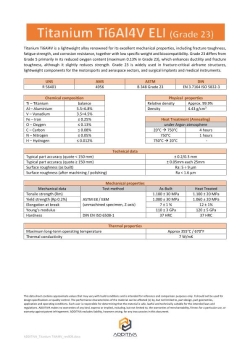
Titanium Ti6Al4V is a lightweight alloy renowned for its excellent mechanical properties, including fracture toughness,
|
|||
|
|
fatigue strength, and corrosion resistance, together with low specific weight and biocompatibility. Grade 23 differs from
|
|||
|
|
Grade 5 primar ily in its reduced oxygen content (maximum 0.13% in Grade 23), which enhances ductility and fracture
|
|||
|
|
toughness, although it slightly reduces strength. Grade 23 is widely used in fracture \- critical airframe structures,
|
|||
|
|
lightweight components for the motorspo rts and aerospace sectors, and surgical implants and medical instruments.
|
|||
|
|
UNS AMS ASTM DIN
|
|||
|
|
R 56401 4956 B 348 Grade 23 EN 3.7164 ISO 5832 \- 3
|
|||
|
|
Chemical composition Physical properties
|
|||
|
|
Ti – Titanium b alance Relative density Approx. 99.9%
|
|||
|
|
Al – Aluminium 5.5÷6.8% Density 4.43 g/cm 3
|
|||
|
|
V – Vanadium 3.5÷4.5%
|
|||
|
|
Fe – Iron ≤ 0.25% Heat Treatment (Annealing)
|
|||
|
|
O – Oxygen ≤ 0.13% under Argon atmosphere
|
|||
|
|
C – Carbon ≤ 0.08% 20°C → 7 50 °C 4 hours
|
|||
|
|
N – Nitrogen ≤ 0.05% 7 50 °C 1 hours
|
|||
|
|
H – Hydrogen ≤ 0.012% 7 50 °C → 20°C \-
|
|||
|
|
Technical data
|
|||
|
|
Typical part accuracy (quote < 150 mm) ± 0.2/0.3 mm
|
|||
|
|
Typical part accuracy (quote ≥ 150 mm) ± 0.05mm each 25mm
|
|||
|
|
Surface roughness (as built) Ra: 5 ÷ 9 µm
|
|||
|
|
Surface roughness (after machining / polishing) Ra < 1.6 µm
|
|||
|
|
Mechanical properties
|
|||
|
|
Mechanical data Test method As \- Built Heat Treated
|
|||
|
|
Tensile streng th (Rm)
|
|||
|
|
ASTM E8 / E8M
|
|||
|
|
(unmachined specimen, Z \- axis)
|
|||
|
|
1.1 8 0 ± 3 0 MPa 1.100 ± 20 MPa
|
|||
|
|
Yield strength (Rp 0.2%) 1.0 8 0 ± 3 0 MPa 1.0 6 0 ± 20 MPa
|
|||
|
|
Elongation at break 7 ± 1 % 1 2 ± 1 %
|
|||
|
|
Young’s modulus 11 0 ± 3 GPa 1 20 ± 5 GPa
|
|||
|
|
Hardness DIN EN ISO 6508 \- 1 3 7 HRC 3 7 HRC
|
|||
|
|
Thermal properties
|
|||
|
|
Maximum long \- term operating temperature Approx 355°C / 67 0°F
|
|||
|
|
Thermal conductivity 7 W/mK
|
|||
|
|
|
|||
|
|
Pagina 1 di 1
|
|||
|
|
|
|||
|
|
|